← All projects

AI Product

Product Analyzer

An AI-assisted tool for faster early-stage product evaluation and idea refinement.

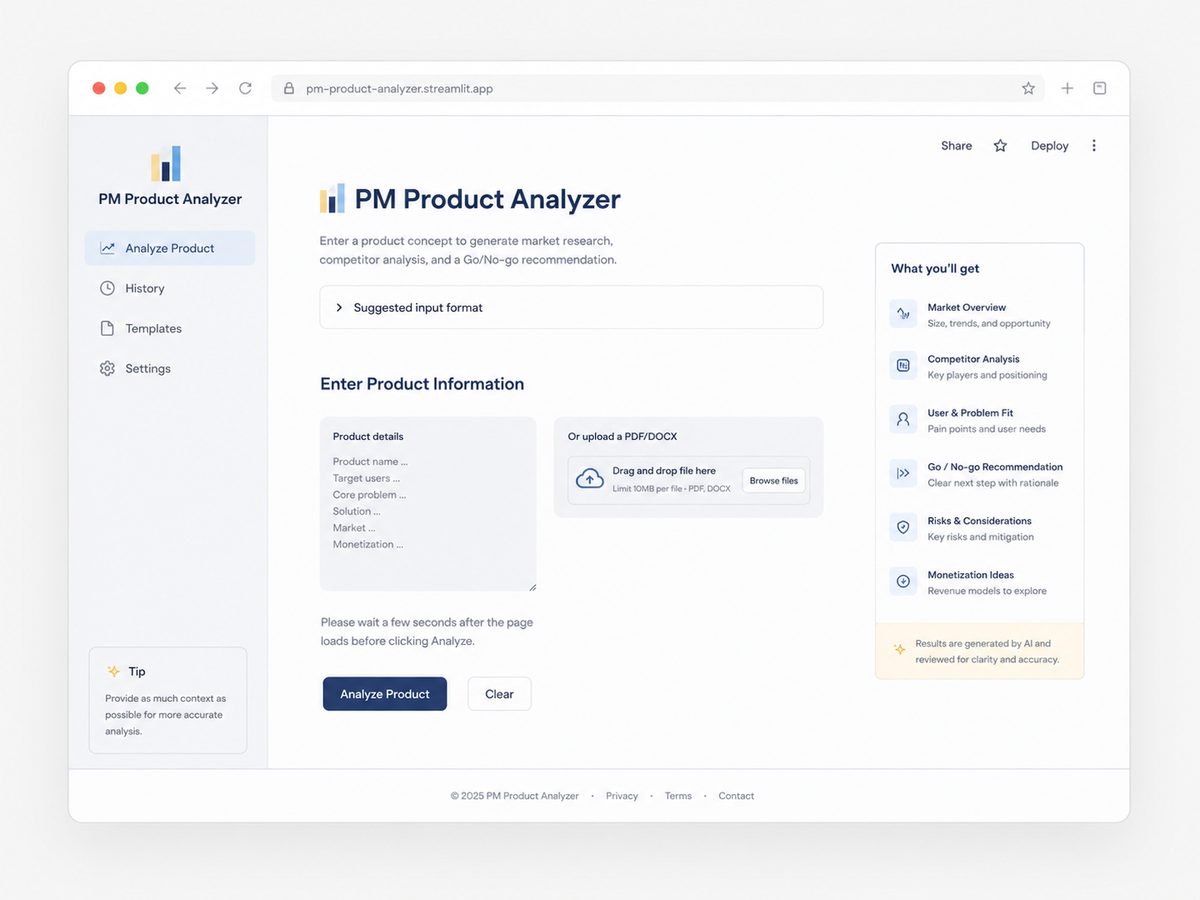
Working Streamlit prototype demonstrated in the walkthrough below.

Product Analyzer — AI Product
01

Overview

Product Analyzer is an AI-assisted product assessment tool designed to help PMs evaluate and refine early-stage ideas faster.

I built a Streamlit prototype that analyzes a concept across five dimensions — market opportunity, competition, user pain points, business model, and viability — then provides a preliminary Go / No-Go direction to guide what should be researched or revised next.

Role
Product Management · Prompt Design · Prototype Development
Timeline
Spring 2026
Team
Individual project
Tools
Streamlit · Python · DeepSeek API
Scope
Problem framing → evaluation framework → prompt design → prototype
02

Problem

How might we help product managers evaluate and refine early-stage product ideas faster?

Early product ideas usually begin with incomplete information. Before deciding whether an idea deserves more investment, a PM still needs to understand the user problem, market opportunity, competitive landscape, business model, and feasibility.

That first-pass analysis can be repetitive and time-consuming, especially when information is scattered across searches, notes, and separate AI conversations.

The opportunity was to use AI as a structured starting point — not to replace product judgment, but to surface weak assumptions faster and help the PM decide what to research, revise, or test next.

03

Product Framework

  • Product need 01

    Product ideas need to be evaluated across more than market attractiveness.

    Design response

    Use a fixed five-dimension structure so every concept is examined through the same product lens.

  • Product need 02

    Free-form prompts make important questions easy to skip.

    Design response

    Encode the evaluation structure into a reusable prompt rather than relying on the user to ask every question manually.

  • Product need 03

    A recommendation is only useful if the reasoning behind it is visible.

    Design response

    Return the assessment by dimension before presenting a preliminary Go / No-Go recommendation.

04

Key Decisions

D01

Fix the evaluation around five product dimensions.

Why
A consistent structure makes it easier to examine different ideas using the same questions.
Tradeoff
The framework simplifies product evaluation and cannot capture every industry-specific consideration.
Result
Every analysis follows the same core structure: market opportunity, competition, user pain points, business model, and viability.
D02

Design the output to surface weak assumptions, not just summarize the idea.

Why
The tool is most useful when it helps PMs see what needs more research, not when it simply restates the concept.
Tradeoff
The assessment may feel less polished or encouraging than a generic AI response.
Result
Each analysis points to gaps, risks, and questions that should be investigated before more time is invested.
D03

Keep the recommendation preliminary.

Why
An LLM-generated assessment should support product judgment, not replace validation or business research.
Tradeoff
The output is less definitive than a simple automated yes/no answer.
Result
The prototype frames Go / No-Go as an early decision aid rather than a final product decision.
05

Prototype

Prototype demo

A walkthrough of the working Streamlit prototype — entering a product concept, running the five-dimension assessment, and reviewing the preliminary Go / No-Go direction.

Input

Users enter an early product concept or description as the starting evidence.

Structured analysis

The prompt evaluates the concept across five predefined dimensions instead of returning one free-form response.

Preliminary recommendation

The output summarizes the assessment and provides a preliminary Go / No-Go direction for further investigation.

06

Outcome / Reflection

What the prototype demonstrates

  • Five-dimension evaluation framework
  • Reusable prompt structure
  • Working Streamlit prototype
  • Preliminary Go / No-Go workflow

What still needs evaluation

  • Consistency across a larger set of product concepts
  • Accuracy of market and competitor claims
  • Unsupported or inaccurate AI-generated claims
  • Whether source requirements improve output quality
  • Whether PMs make better decisions using the tool
  • Prompt quality across different industries
Product learning
The most useful part of the AI system was not the model itself. It was deciding what questions the model should answer consistently.
Key tradeoff
Structure versus flexibility: a fixed framework makes outputs easier to compare, but it also limits how far the model can explore outside the predefined dimensions.
What I'd do next
Build a benchmark set of product concepts and score prompt versions for relevance, completeness, evidence quality, consistency, actionability, and hallucination risk, then add stronger source requirements before treating the output as decision-grade analysis.