← All projects

Consumer Tech / IoT

LumiMirror

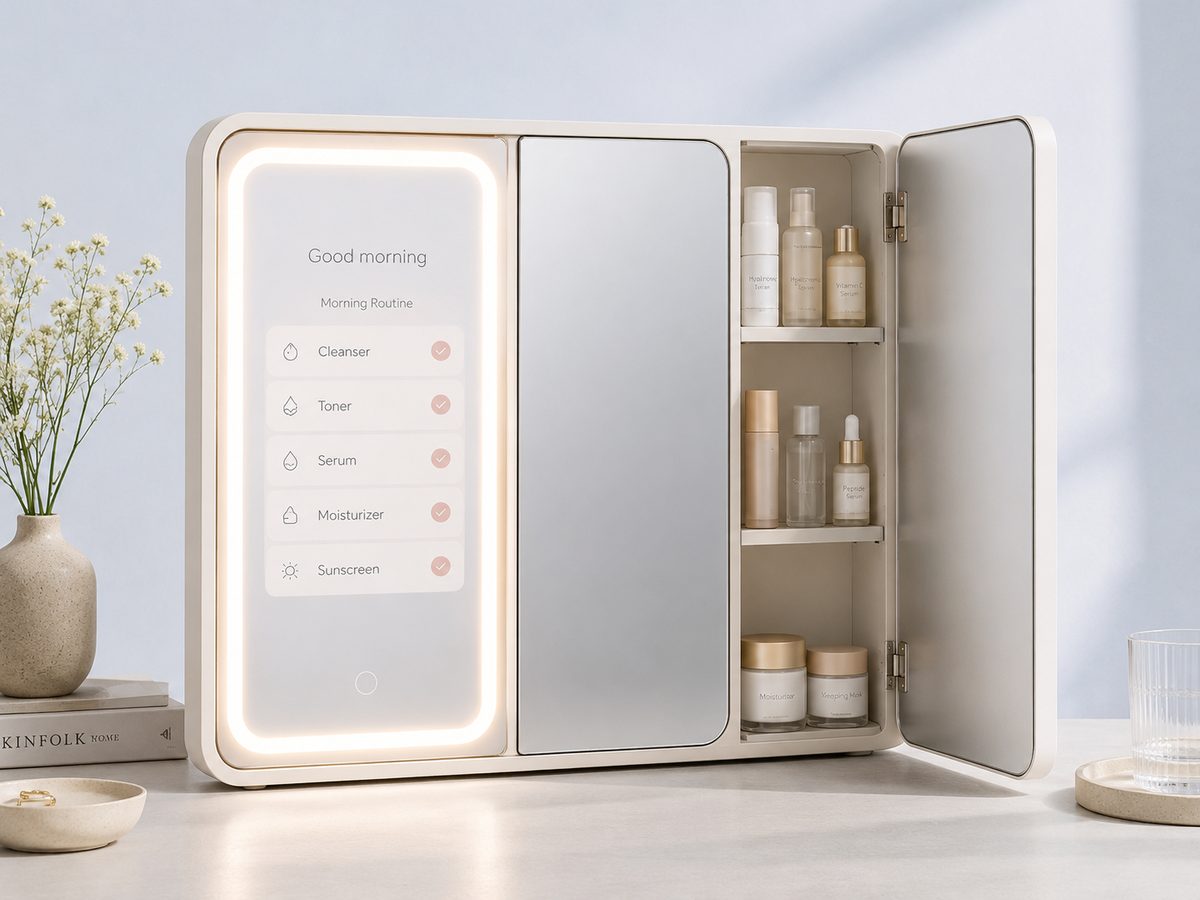
A connected skincare mirror cabinet designed to guide routines, organize products, and make product-date tracking easier at the moment of use.

LumiMirror — Consumer Tech / IoT
01

Overview

LumiMirror is a connected skincare mirror cabinet concept designed around a simple question: how can routine guidance and product tracking fit naturally into the place where skincare already happens?

The project explored the product definition across the physical mirror, companion app, product-identification methods, and product scope. My work focused on translating the user problem into product requirements, comparing automation approaches, and shaping the mirror/app interaction model into a testable prototype.

Role
Product Definition · Research · Requirements · Prototyping
Timeline
Summer 2026
Team
3-person product development team
Tools
Figma · Fusion 360 · Emergent · Rapid Prototyping
Scope
Problem framing → requirements → interaction model → hardware/software tradeoffs → prototype
02

Problem

How might we simplify a multi-step skincare routine by reducing unnecessary decisions at the moment of use?

Skincare routines can involve multiple products, different AM/PM sequences, and product-specific timing or replacement needs. The challenge is not access to more information — it is reducing the number of decisions users have to make while the routine is happening.

When users have to remember what comes next, whether a product fits the routine, or when it should be replaced, the experience becomes easy to second-guess. LumiMirror was designed to simplify that moment by bringing routine guidance and product context into the place where the routine already happens.

The mirror supports immediate routine decisions, while the companion app handles deeper setup, product management, reminders, and personalized recommendations.

03

Research to Product Direction

  • Research finding 01

    Users need help managing sequence, timing, and product context during the routine.

    Product decision

    Make routine guidance the primary mirror experience rather than adding more skincare content.

  • Research finding 02

    Product setup becomes frustrating if recognition depends on one unreliable automation method.

    Product decision

    Use barcode and manual entry as the dependable baseline, while keeping RFID as an assisted layer.

  • Research finding 03

    Some interactions are quick and contextual, while others require more detailed input.

    Product decision

    Use the mirror for immediate routine guidance and the companion app for setup, editing, reminders, and personalized recommendations.

04

Key Decisions

D01

Split the experience across two surfaces rather than force one to do both.

Why
Routine steps have to be readable mid-routine, with wet hands and no phone in reach. Registration, AM/PM sequencing, and editing need a keyboard and a screen the user can sit with.
Tradeoff
Two surfaces to design, build, and keep in sync instead of one.
Result
Neither surface carries interactions it handles badly — but the mirror is only useful after the app has been set up, so onboarding now sits on the critical path.
D02

Accept manual setup effort rather than depend on RFID recognition.

Why
Barcode scanning and manual entry behave predictably across packaging. RFID would cut repeated interaction after setup, but only if tags read reliably through cabinet glass, product residue, and stacked bottles — which the prototype could not test.
Tradeoff
First-run setup stays manual, so the product asks more of the user than automatic recognition would promise.
Result
The core experience does not depend on RFID working, and the architecture still leaves room to add it if testing supports it.
D03

Defer AI skin analysis until the core routine experience is validated.

Why
Skin analysis brings its own accuracy, privacy, and trust requirements, and it has to be maintained once shipped. None of that is worth taking on before knowing whether guidance at the mirror gets used at all.
Tradeoff
The product loses its most eye-catching demo feature, and with it an easy answer to why this is not just a phone app.
Result
Scope stayed on routine guidance, product registration, date tracking, and reminders — the parts the prototype could actually demonstrate.
05

Prototype

The prototype brought the product decisions together into one end-to-end experience across the mirror and companion app.

Mirror-side walkthrough

A short walkthrough of the mirror-side prototype — routine guidance, step progression, product status, and expiration alerts.

Mirror experience

Step-by-step routine guidance, product context, and session completion at the moment of use.

Companion app

Product registration, AM/PM routine setup, reminders, product management, and personalized recommendations.

Prototype demo

A walkthrough of the intended mirror and app interaction. Some hardware behaviors are simulated and still require technical validation.

06

Outcome / Reflection

What this project established

  • Product scope and core use cases
  • Mirror / companion-app interaction model
  • Prototype flow
  • Product-identification tradeoff

What still needs validation

  • RFID reliability in real product-use conditions
  • Whether users prefer mirror guidance over phone guidance
  • Willingness to pay
  • Long-term use and retention
Product learning
The hardest decision was not what to automate, but what the product could rely on confidently.
What I'd do next
Run task-based usability testing, then validate RFID feasibility and willingness to pay before expanding the feature set.