← All projects

Physical Product

Split Air Fryer

A modular air fryer concept designed to make the hardest-to-clean components easier to access, remove, and wash.

Split Air Fryer — Physical Product
01

Overview

Split Air Fryer is a physical-product redesign focused on one recurring frustration: cleaning.

The team explored multiple approaches — including self-cleaning systems, removable liners, and modular architectures — before selecting a split-top design that separates the heating assembly from the washable cooking chamber.

My work included user research, concept evaluation, requirements, product architecture, and prototype development.

Role
Product Development · Research · Concept Evaluation
Timeline
Fall 2025
Team
4-person product development team
Tools
Fusion 360 · 3D Printing · Prototyping · Concept Evaluation
Scope
User research → concept generation → down-selection → product architecture → prototype
02

Problem

How might we make air-fryer cleaning easier without making the appliance more complicated to use?

Our research showed that cleaning was not a minor inconvenience — it influenced how often some users wanted to use the appliance.

The hardest areas to clean were not only the basket, but also the heating element and internal chamber.

The product challenge became architectural: instead of adding another cleaning accessory, could the appliance itself be easier to take apart and wash?

03

Research / Evidence

  • Insight

    None of the four participants interviewed cleaned the heating element.

    Product implication

    Cleaning access needed to extend beyond the removable basket.

  • Insight

    Two of the four said they would use their air fryer more often if cleaning were easier.

    Product implication

    Cleaning friction could affect product usage, not only maintenance.

  • Insight

    Participants preferred dishwasher-safe components and easier-to-clean structures over separate cleaning accessories.

    Product implication

    Prioritize product architecture and removable parts instead of adding a cleaning tool.

Generative study, four participants — directional, not statistical.

04

Design Criteria

Before comparing concepts, the team translated the research into four weighted criteria for down-selection.

01Cleanability · 35%
The concept needed to improve access to the parts users struggled to clean most.
02Affordability · 28%
The solution needed to remain accessible rather than depend on expensive self-cleaning systems.
03Usability · 22%
Cleaning improvements should not make everyday operation more complicated.
04Durability · 15%
Repeated removal, washing, and reassembly should not compromise the product over time.

Affordability mattered because the concept was intended to remain accessible to younger, price-conscious users rather than depend on premium self-cleaning technology — a design intent, not a validated market finding.

These criteria became the basis for the Pugh Matrix used to compare the concepts.

05

Concept Exploration

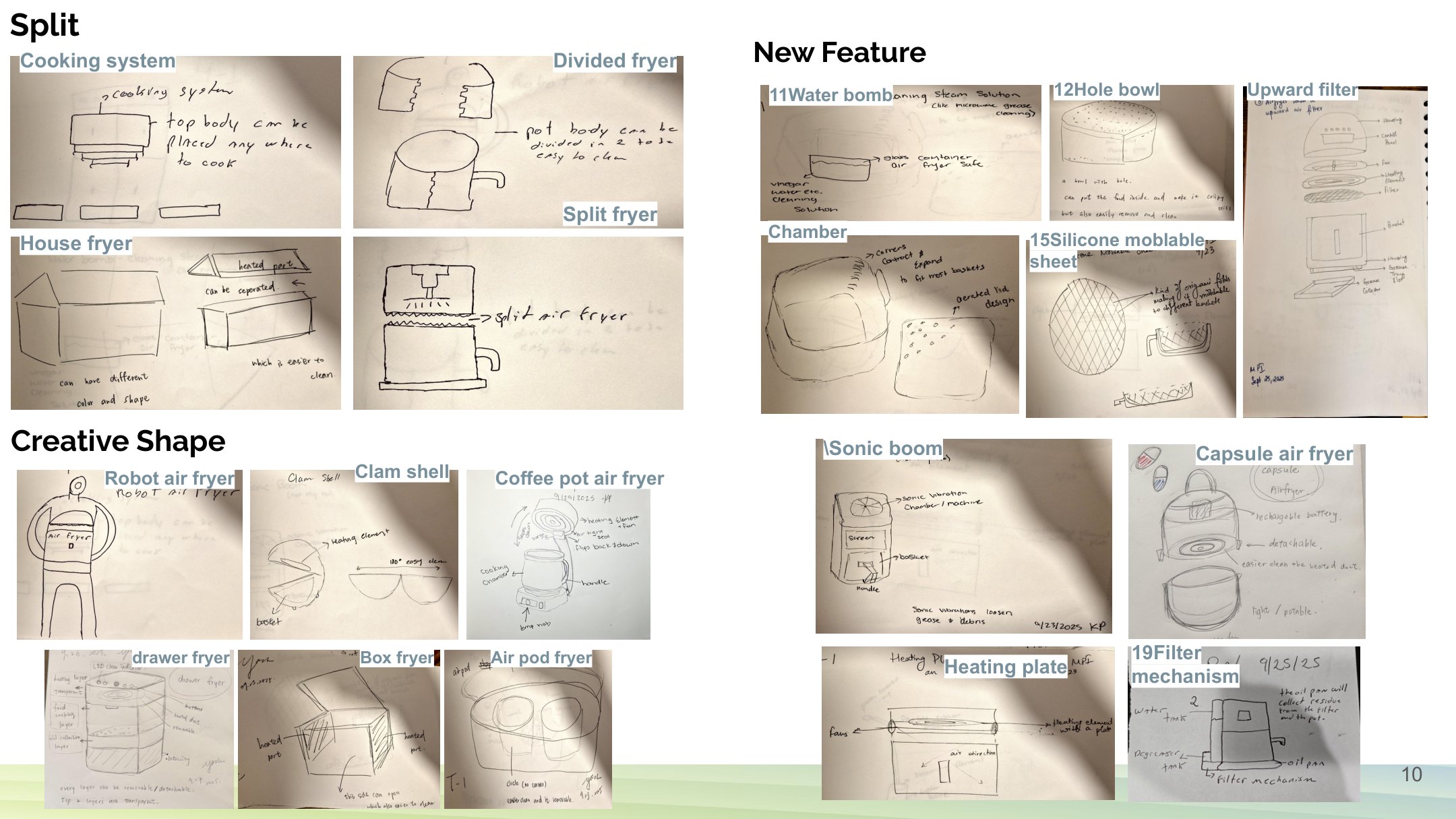
We explored concepts across three directions: Split Architectures, Creative Shapes, and New Features. Within those directions, the team considered options such as self-cleaning systems, removable liners, revised basket geometries, and cleaning aids.

The goal was to avoid committing to the first intuitive solution before comparing different ways to reduce cleaning effort.

Concept sheet grouping early air-fryer sketches into split architectures, creative shapes, and new features
Early concepts, grouped by direction before down-selection.
06

Key Decisions

D01

Choose the split-top architecture over the silicone-liner concept.

Why
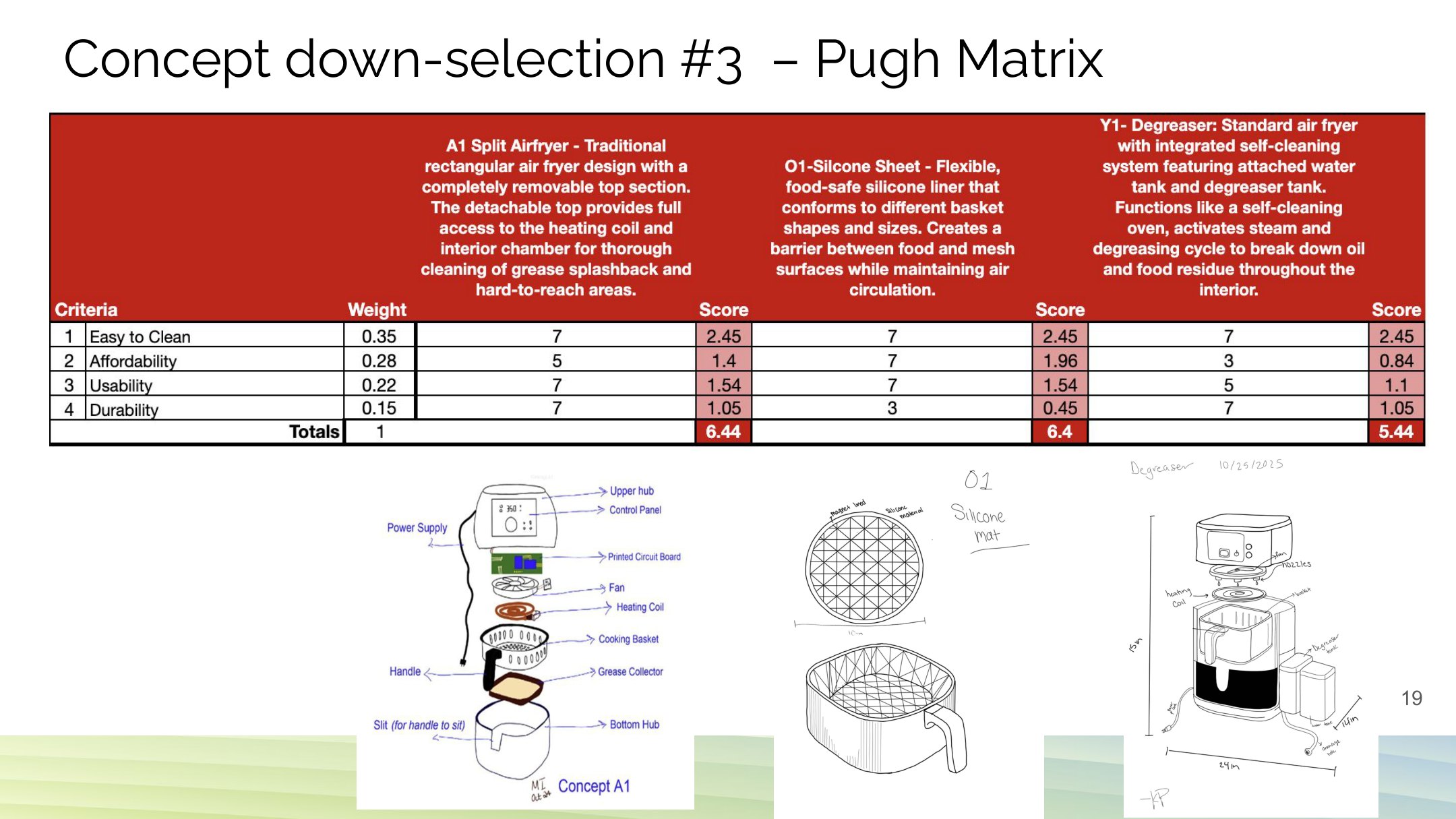
The two concepts were nearly tied in the weighted Pugh Matrix: 6.44 for the split-top and 6.40 for the silicone liner. The liner scored better on affordability, but the split-top scored higher on durability and addressed access to the harder-to-clean internal components more directly.
Tradeoff
The split-top architecture is more mechanically complex than adding a removable liner and still requires users to separate and wash components manually.
Result
The team selected the split-top direction because it better matched the project’s primary goal: improving access to the parts users struggled to clean, while still balancing affordability, usability, and durability.
D02

Prioritize cleanability over added automation.

Why
User research showed stronger interest in dishwasher-safe, accessible components than in separate cleaning aids.
Tradeoff
The solution feels less futuristic than an automated cleaning system.
Result
The product direction stayed centered on the core user problem instead of adding features around it.
D03

Separate the heating assembly from the washable lower chamber.

Why
The areas users struggled to clean were physically connected to the heating system in conventional air fryers.
Tradeoff
The interface creates new sealing, thermal, and safety requirements.
Result
The selected architecture makes the lower cooking chamber and basket more accessible for washing.
Pugh matrix scoring the split, silicone-liner, and degreaser concepts against weighted criteria
Concepts were scored against the weighted criteria to guide the down-selection; the split-top direction came out narrowly ahead.
07

Prototype & Engineering

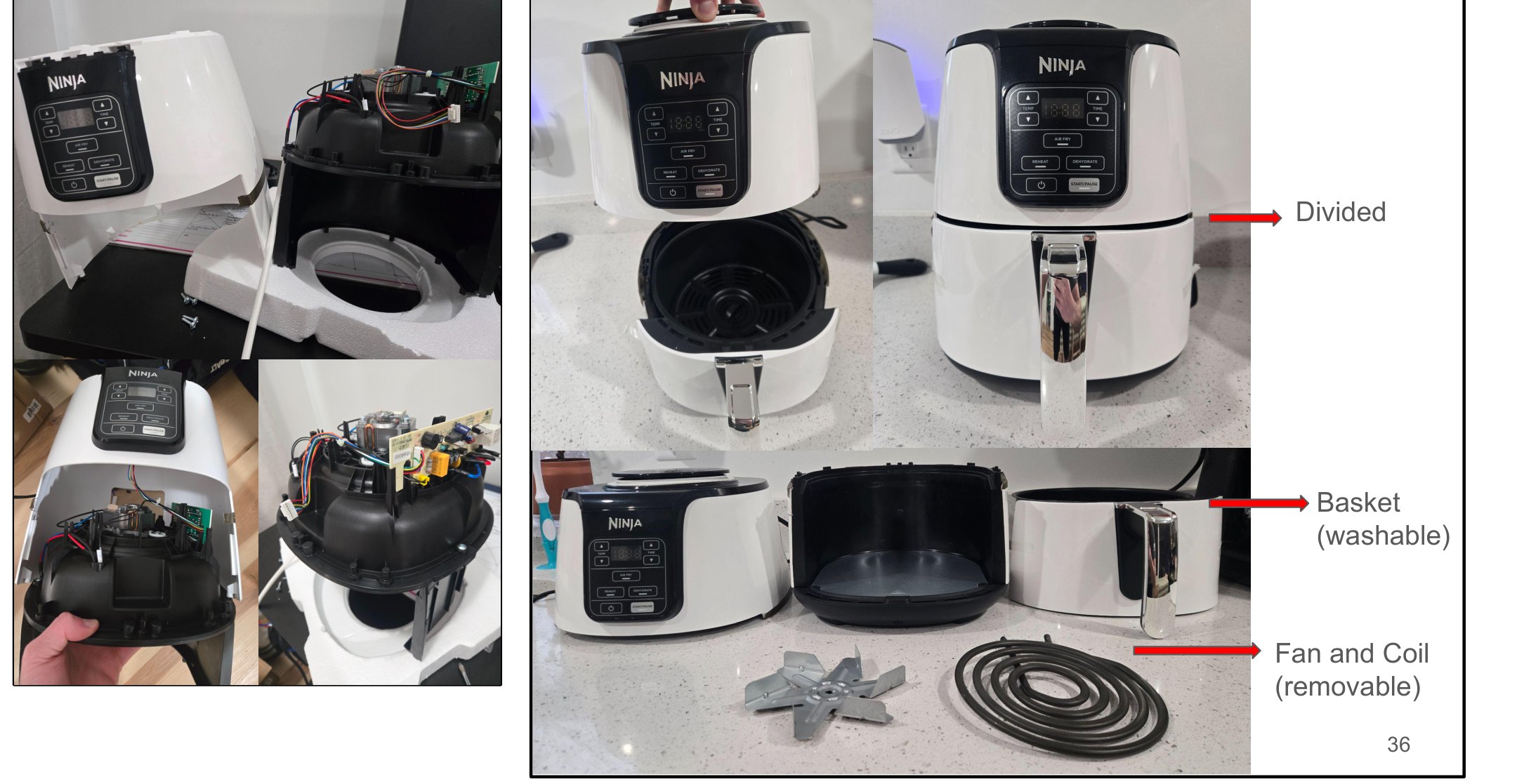
The selected concept was translated into a physical prototype by modifying an existing air fryer and separating the upper heating assembly from the lower cooking section.

Product architecture

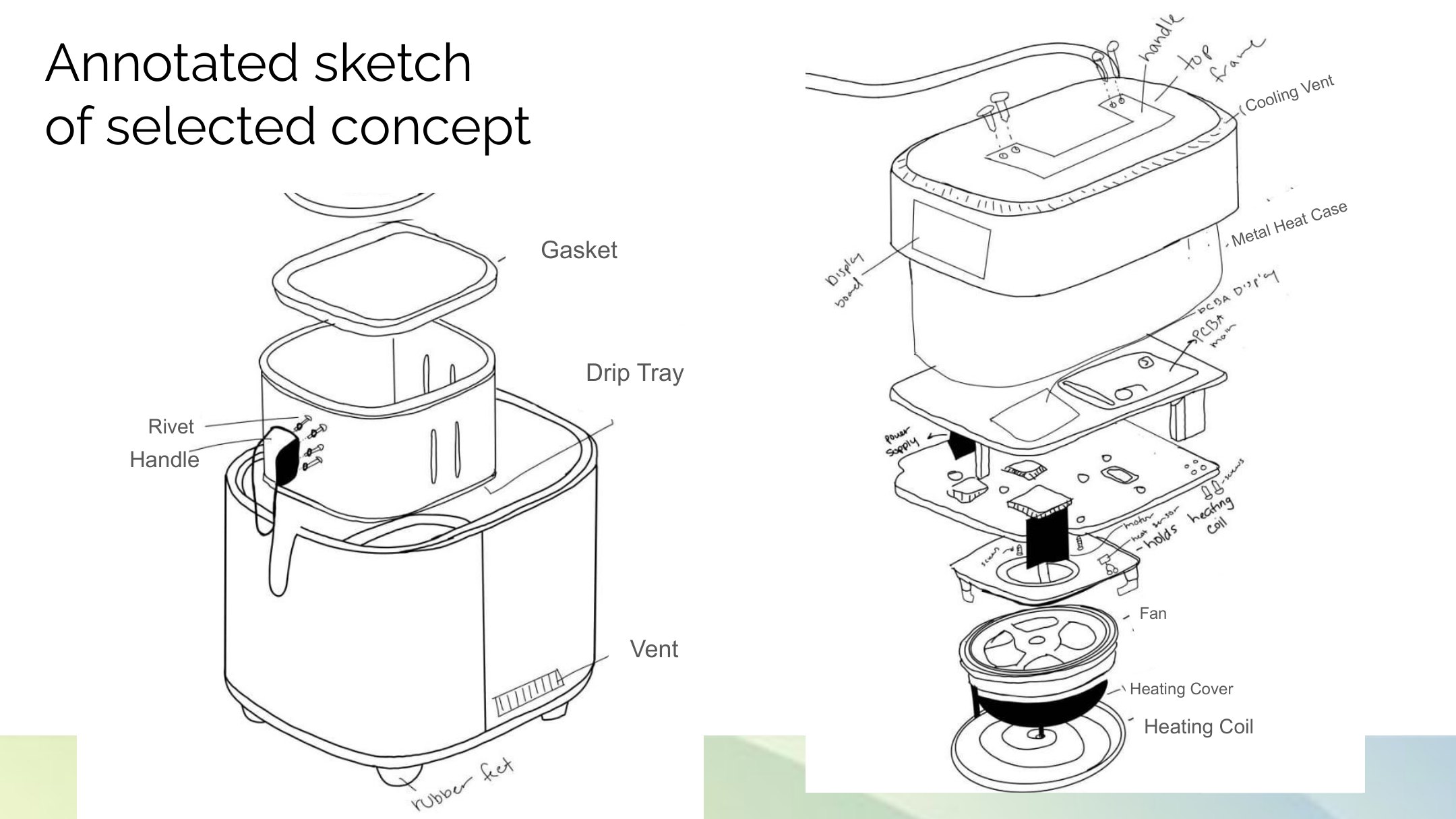
The final concept separates the heating and fan assembly from the lower cooking chamber so the washable components can be accessed more directly.

Engineering definition

The team documented the major parts, interfaces, sealing points, vents, sensors, and assembly structure needed to support the modular design.

Physical prototype

A modified air fryer was used to demonstrate the split architecture, removable fan and coil assembly, and washable basket / chamber concept.

Annotated sketch of the selected split concept beside an exploded view of the upper heating assembly
The selected concept: gasket and vents on the split line, fan and heating coil in the upper assembly.
Photographs of the modified air fryer prototype split into upper and lower sections, with the fan and heating coil removed
A modified air fryer showing the split line, washable basket and chamber, and removable fan and coil. Not a working cooking unit.
08

Outcome / Reflection

Project outputs

  • 4-user generative interview study
  • Concept-generation set
  • Concept-selection matrix
  • Selected split-top product architecture
  • Engineering / assembly definition
  • Physical prototype with a removable heating and fan assembly

What still needs validation

  • Thermal sealing under real cooking conditions
  • Heat isolation and user safety
  • Dishwasher durability
  • Repeated latch / separation cycles
  • Manufacturing feasibility at production scale
Product learning
The most useful design change was architectural, not cosmetic. Making the product easier to clean required changing how the appliance comes apart.
Key tradeoff
Simplicity versus automation: the split architecture requires manual cleaning, but avoids the complexity of a self-cleaning system.
What I'd do next
Build a functional thermal prototype and test sealing, heat isolation, and repeated assembly cycles before refining the industrial design.